
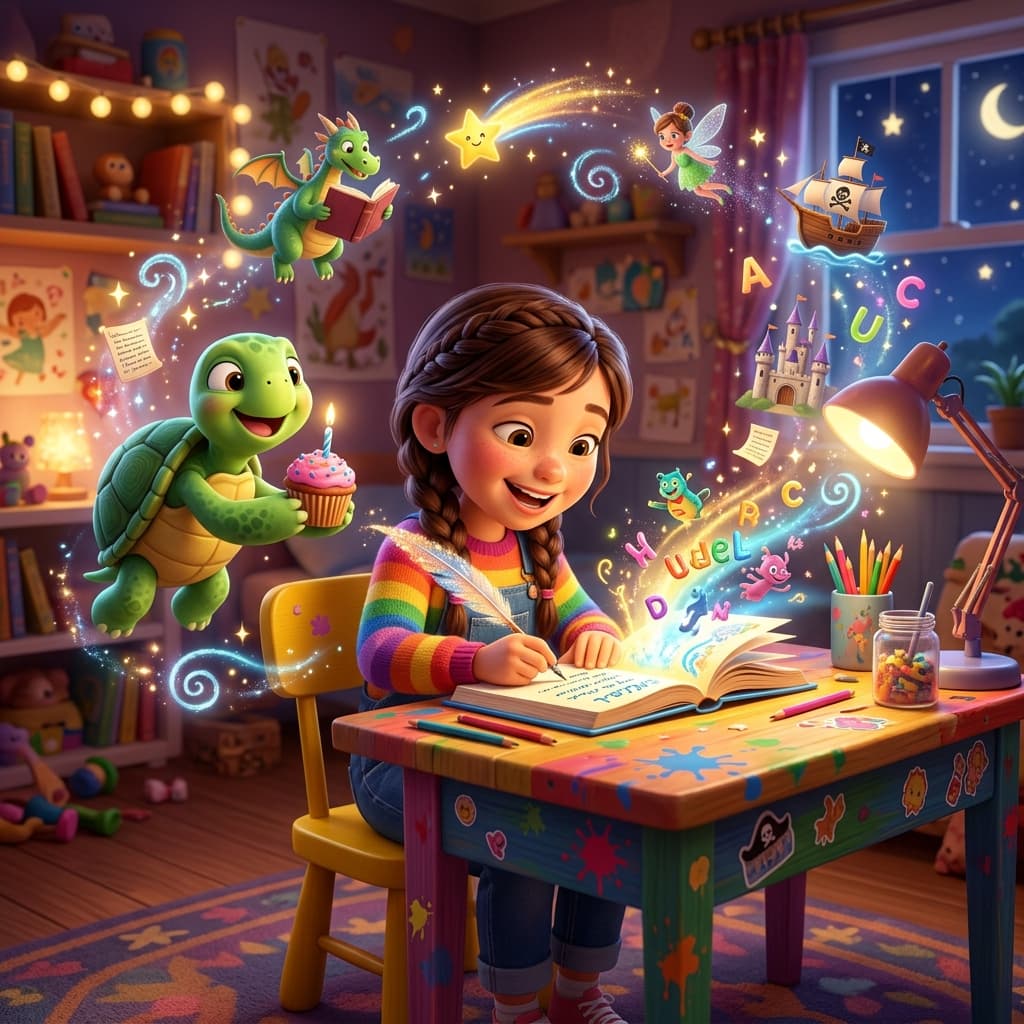
"I don't know what to write."
If you've heard this from your child while staring at a blank piece of paper, you aren't alone. For many kids, creative writing feels less like an adventure and more like a high-pressure test. They worry about spelling, grammar, and whether their idea is "good enough."
This performance anxiety is exactly what kills creativity.
The latest trends in education focus on "low-stakes" writing. The goal isn't to write a perfect essay; the goal is to build a storytelling habit through play. Here are three proven ways to get kids writing without the frustration, using modern tools like AI to help.
1. Mute the TV and Write the Script
This is a favorite among teachers who practice "stealth learning." Turn on your child's favorite cartoon or a funny animal video, but put it completely on mute.
Give them a notebook or open a tablet, and ask them to write down what the characters are saying.
Because the visual context is already there, the pressure of "coming up with an idea from scratch" is completely gone. They can focus entirely on dialogue, humor, and voice. It feels like a game, but they are actively practicing narrative structure.
2. Use "Invented Spelling" and Emotional Lockers
When a child is in the flow of a story, stopping them to correct "their" vs. "there" is a surefire way to ruin the momentum.
Encourage them to keep a private journal or notebook—an "emotional locker"—where nobody is allowed to grade them. Let them know that in this book, spelling absolutely does not matter. The only rule is that they have to get their ideas down.
When children know an audience isn't judging their mechanics, they take bigger creative risks.
3. Use an AI Story Maker as a Co-Pilot
Sometimes, the physical act of handwriting or typing is what slows a child down. Their brain works faster than their hands, leading to frustration.
This is where an educational AI story maker like MintMyStory shines. Instead of staring at a blank page, kids can collaborate with the AI.
- Oral Storytelling: Have your child dictate their story idea out loud. "A story about a ninja turtle who loves baking cupcakes."
- Prompting the AI: Enter that idea into the generator.
- The Director's Chair: When the AI generates a paragraph or an illustration, the child gets to be the "Director." Ask them: "Did the AI get it right? Should we tell the AI to make the turtle's frosting pink instead of blue?"
By stepping into the role of a director or editor, the child is still engaging in critical thinking, descriptive language, and narrative pacing—but the heavy lifting of the initial draft is handled.
Keep it Fun
Writing shouldn't feel like a chore. By removing the pressure of perfection and using tools that feel like play, you can help your child discover the joy of telling their own stories.
Turn Your Child's Imagination into a Real Book
Don't let blank-page anxiety hold your child back. Give them the ultimate co-pilot. We're giving 100 Free Tokens to new users this week so you can try it completely risk-free.


