
If you have a child who struggles with reading, getting them to sit down with a book can feel like a battle. They might stumble over words, lose their place on the page, or simply get frustrated and give up.
But what if there was a way to "hack" their learning process, making it easier for their brain to absorb the story without the intense frustration of sounding out every single syllable?
Enter Audio-Visual Synchronization.
Often referred to as "read-aloud" or "read-along," the simple act of listening to a professional narrator while looking at the text and illustrations is one of the most scientifically proven ways to accelerate reading comprehension. Here is the science behind why it works so well.
The Science of Dual Coding Theory
In 1971, cognitive psychologist Allan Paivio introduced Dual Coding Theory. The core concept is remarkably simple but profoundly effective: the human brain uses two completely separate channels to process information—one for visual information (images and written text) and one for verbal information (spoken words).
When a child tries to read a difficult book silently, they are overloading their visual channel. Their brain has to decode the shapes of the letters, translate those shapes into sounds, and then combine those sounds into a word that has meaning. For a struggling reader or a child with dyslexia, this process is exhausting.
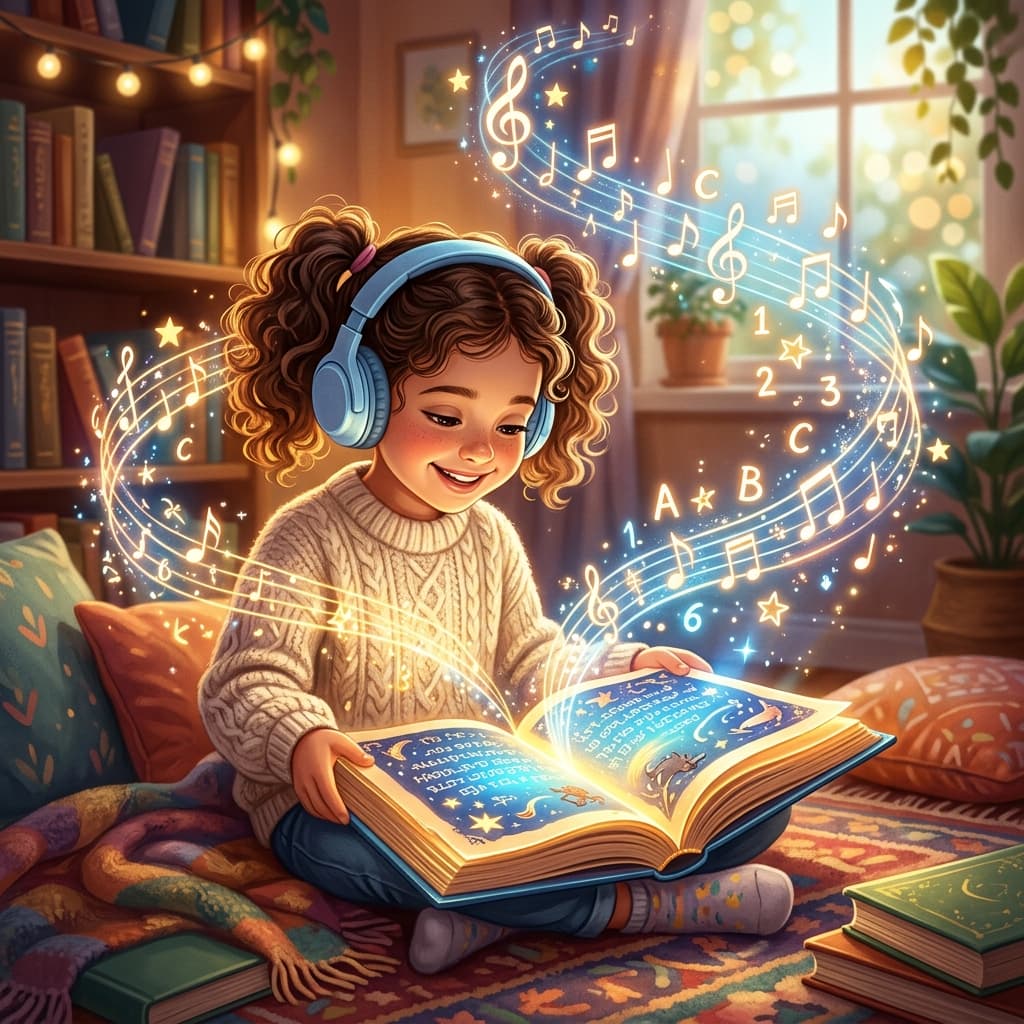
However, when a child listens to a story while looking at the book, they activate both channels simultaneously. According to Dual Coding Theory, when both the visual and verbal channels process the same information at the same time, the brain creates a much stronger, more resilient memory. The auditory input acts as a bridge, helping the child decode the visual text without the heavy cognitive strain.
Building "Phonemic Awareness" Faster
One of the biggest hurdles in early literacy is phonemic awareness—the ability to hear, identify, and manipulate individual sounds in spoken words.
When a child listens to a fluent reader, they aren't just hearing a story. They are absorbing critical data about how language works:
- Pacing and Prosody: They learn where to pause for a comma and how to inflect their voice for a question mark.
- Decoding Difficult Words: When they see a complex word like "knight" but hear the narrator say "nite," their brain instantly maps the silent 'k' and 'gh' to the sound.
- Vocabulary Expansion: Children can comprehend spoken language at a much higher level than they can read it. Audio narration exposes them to advanced vocabulary they wouldn't be able to read on their own.
The Screen-Time Dilemma
Many parents know the value of reading aloud, but let's be honest—you can't always sit and read for an hour every time your child wants a story.
Historically, parents have turned to TV or tablets, but passive video consumption does not trigger the benefits of Dual Coding Theory. Fast-paced cartoons bypass the language-decoding process entirely. The child watches the action instead of processing the words.
How MintMyStory Bridges the Gap
We built MintMyStory specifically to leverage the science of Dual Coding Theory. We didn't just build a story generator; we integrated professional Edge-TTS (Text-to-Speech) neural narration into every single book.
When your child creates a personalized story on our platform, they don't just get text and pictures. They get a fully narrated, professional audiobook experience.
- Paced for Learning: Our narration is paced naturally, allowing the child to follow the text with their eyes while the voice guides them.
- ADHD-Friendly: By anchoring the child's attention with both audio and visual inputs, children with ADHD are far less likely to lose focus.
- Independent Practice: Your child can "read" advanced, exciting stories about themselves completely independently, building confidence and a genuine love for books.
If you have a reluctant reader, try handing them a story with the audio turned on. You might be surprised at how quickly the frustration disappears.
Verified Scientific References
- InstructionalDesign.org - Dual Coding Theory (Allan Paivio). A breakdown of the cognitive psychology behind processing visual and verbal information simultaneously. Read the overview here
- Reading Rockets - Benefits of Audiobooks for All Readers. A comprehensive guide from a national literacy initiative on how audiobooks improve decoding, fluency, and comprehension. Read the full article here
Turn Screen Time into Literacy Time
Create a personalized, fully-narrated storybook for your child and let them experience the magic of Dual Coding. Start Creating for Free


