
Second grade is the year when children make the leap from "telling events" to "telling a story." A 1st grader says: "And then we went to the park, and then there was a dog, and then we went home." A 2nd grader is ready to say: "We were stuck at the park because the dog had our ball, and we had to figure out how to get it back."
That shift — from sequencing to conflict and resolution — is the central narrative development at ages 7–8. Writing prompts for this age should do one thing above everything else: give the child a problem to solve. A problem forces a middle. A middle demands a resolution. And now you have a story.
The 40 prompts below are organized into four categories. Each prompt includes the core conflict explicitly so that children who need scaffolding have a clear direction, while children who want more freedom can use it as a springboard.
What makes a good 2nd grade writing prompt
According to research from the International Literacy Association, children at this age benefit most from:
- A clear protagonist (usually themselves or an animal stand-in)
- A concrete problem with a specific constraint
- An emotionally accessible stakes (not "save the world" — "save the birthday cake")
- A resolution that requires a choice, not just luck
The prompts below apply these principles. The goal isn't to produce a polished story — it's to help the child understand that every good story has a shape: something happens, something goes wrong, and someone figures it out.
Category 1: Problem-Solving Adventures (10 prompts)
These are the highest-engagement prompts for 2nd graders because the problem is immediately solvable in their imagination.
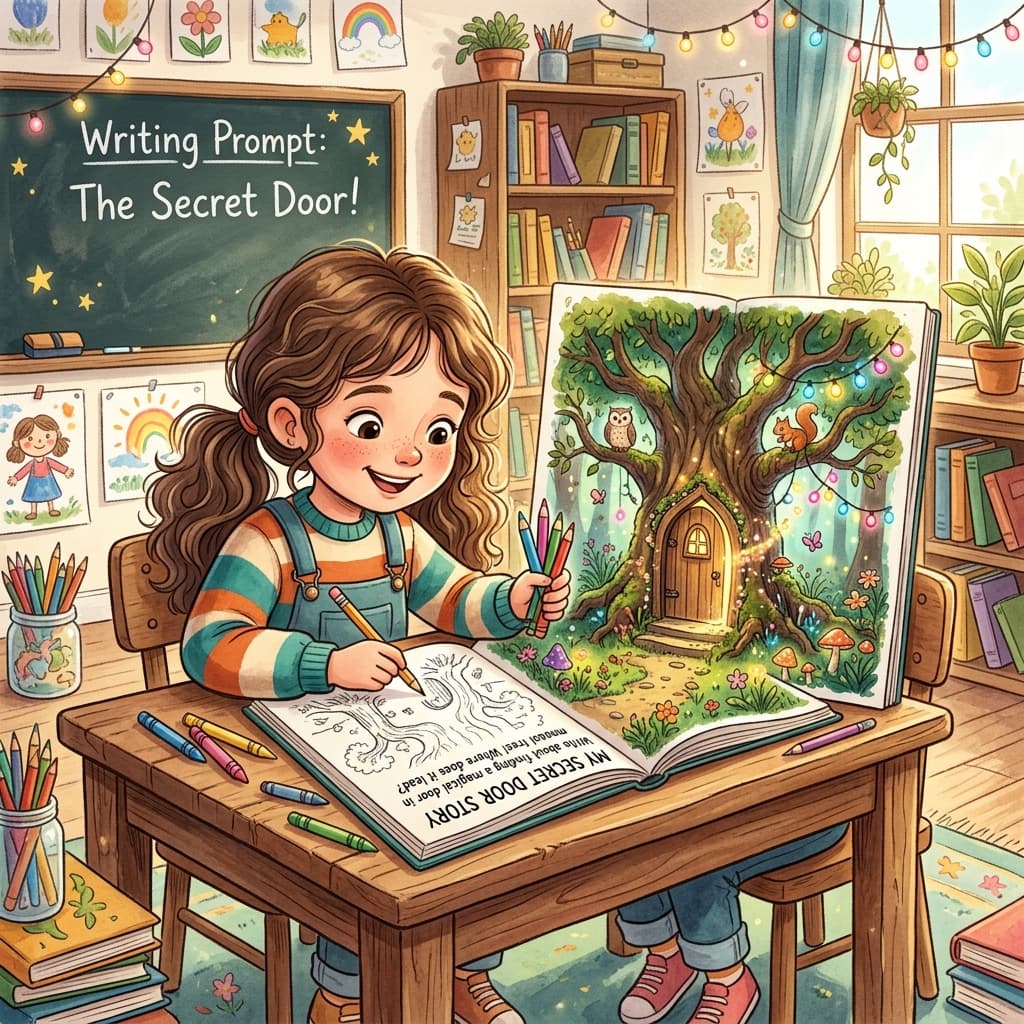
- The Secret Door. You find a tiny door at the base of a tree. You open it and crawl in. Inside it's bright and warm — and there are 10 creatures who all need help with the same problem. What is it?
- The Lost Penguin. A penguin gets on the wrong bus and ends up in the desert. He's very hot, very confused, and has one item in his backpack. What is it, and how does it help him get home?
- The Helpful Robot. You build a robot to clean your room. It makes the mess much worse. You have 20 minutes before your parents come home. Write your three-step plan.
- The Shrinking Potion. You drink it by accident and shrink to the size of an ant. You are stuck in the kitchen. Write how you get to your bedroom — what do you climb, what dangers do you avoid?
- The Sleepy Dragon. A dragon falls asleep blocking the school entrance. Class starts in 5 minutes. You and your class have to wake it up without making it angry. What works?
- The Flying Bicycle. Your bike takes off into the sky. You can steer, but you can't figure out how to land. You fly over three places before you find the answer. What are the three places?
- The Mischievous Shadow. Your shadow detaches and runs away. It keeps getting you in trouble — it sits in the wrong desk, takes food from the cafeteria, scares the librarian. How do you catch it?
- The Backwards Clock. The classroom clock starts running backward. Time is going backward at exactly the speed of the clock. You have 10 minutes before the whole day unravels. What do you do?
- The Inside-Out Umbrella. It's raining. Your umbrella turns inside-out and now it catches rain instead of blocking it. Write the three terrible things that happen and the one clever solution.
- The Missing Voice. You wake up and your voice is gone — but it's somewhere in the house. You can hear it talking in another room. Write how you find it and get it back.
Category 2: Magical School Days (10 prompts)
Schools are familiar ground, which makes them perfect for a fantastical twist. Children at this age find school magic especially funny.
- The Substitute Who Is a Pirate. She arrived in a boat on the playground. She is teaching reading, but she keeps calling letters by pirate names. How do you pass the quiz at the end?
- The Lunch That Came Alive. At lunch, your sandwich starts talking. It doesn't want to be eaten. It has very good reasons. Do you listen? What happens?
- The Library Spell. Every book in the school library has started telling a different story than the one printed inside. Nobody knows why. You find the one book that explains it.
- The Classroom Pet Escape. The class hamster escapes and is now loose in the school. You are assigned to catch it before the principal finds out. Write your search, step by step.
- The Chalk That Draws Real Things. The new chalk makes whatever you draw appear in real life. A student draws a horse. Now there's a horse in the classroom. Who draws the solution?
- The 100-Foot Pencil. Your pencil grows 100 feet long. You can't put it down without it falling through the ceiling. You still have a writing test to complete. What happens?
- The Science Experiment That Goes Very Right. You were supposed to make a small volcano. You made a small sun. It's very warm in the classroom now. Write the evacuation plan.
- The Report Card Mistake. Your report card says you got an A in a subject you've never taken. You go to find out why, and what you discover explains something strange that's been happening at school all year.
- The Whispering Wall. One wall in your school whispers helpful facts when you press your ear against it. The problem: it's in the middle of a hallway. Write how you use it without anyone knowing.
- The Field Trip Confusion. Your class was supposed to go to the science museum. The bus driver takes a wrong turn and you end up somewhere completely different — but more interesting. Where, and what do you learn?
Category 3: At Home, But Weird (10 prompts)
Home-based prompts have the highest completion rate because children know the setting in detail — which means they can focus on the story, not on building the world.
- The Pizza Monster. Your pizza slice comes alive and runs away. You chase it through three rooms of your house. It has a reason for running. What is the reason?
- The Magic Shoes. They make you jump over buildings. That's not the problem. The problem is that you jumped too high and now you're on a cloud. A small one. Not comfortable.
- The Talking Backpack. Your backpack starts giving you advice — but it's always wrong in exactly the same way. What pattern do you notice, and how do you use the pattern to get the right answer?
- The Refrigerator Door to Somewhere Else. You open the fridge for a snack and step into somewhere completely different. Write the two things you have to do to get back home.
- The Bed That Moved. You wake up and your bed has quietly moved to the backyard while you were sleeping. You don't know why. Your cat looks guilty.
- The New Neighbor. A family moves in next door. The house looks normal. But their dog has three tails. Their mailbox is upside down. And their lights turn on and off in patterns. You decide to say hello.
- The Grandparent's Attic. You find a box in your grandparent's attic. It says "Do Not Open Until You're Ready." You feel ready. Inside is not what you expected.
- The Weekend Without Rules. Your parents say you can make three house rules for this weekend only. You make them. By Saturday afternoon, you realize the rules have complicated side effects.
- The Rainstorm Inside. It starts raining in your living room — just a light drizzle, right over your favorite chair. The rest of the house is fine. What is causing it, and how do you fix it?
- The Night the Stars Fell Into the Yard. Three small stars land in your backyard at 9pm. They are not dangerous. They are lost. They need to get back up. You have until morning.
Category 4: Brave Feelings & Choices (10 prompts)
These prompts help children process social and emotional themes through the safe distance of fiction. Research shows narrative can increase children's empathy and emotional vocabulary significantly.
- The Wrong Choice. Write about a character who makes a wrong choice — not a bad person, just someone who made a mistake. Write what they did, why, and what they did to fix it.
- The New Place. A character moves to a new city, a new school, or even a new planet. Write about their first day and the one unexpected thing that makes them feel better.
- The Two Best Friends Fight. They haven't spoken in three days. Write the conversation where they finally talk — what do they say? What do they realize?
- The Character Who Is Really Good at Something Nobody Notices. Write about their best day — the day someone finally sees it.
- The Fair Share Problem. There's one piece of cake left. There are four people. Write how your character decides what to do.
- The Dare. Someone dares your character to do something. The character has to decide: does wanting to fit in matter more than what they know is right? What do they choose?
- The Sick Friend. Your character's best friend is sick and can't come to an important event. Write what your character does with the empty seat next to them.
- The Forgotten Promise. Your character made a promise and forgot. They remember on the exact day it was supposed to happen. Write what they do next.
- The Very Different Family. Your character visits a friend's house and notices their family is very different from their own. Not better, not worse — just different. Write three things your character notices and what they think about them.
- The Thank You That Took Too Long. Your character wants to thank someone but keeps waiting for the right moment. Write why they kept waiting, and write the moment they finally say it.
Teaching 2nd graders the Beginning-Middle-End structure
One of the most effective ways to use these prompts in the classroom or at home is the 3-Panel Story Map:
Draw three boxes on a piece of paper. Label them: What happened first? What went wrong? How was it fixed?
Ask the child to fill in each box with 1–2 sentences before writing. This removes the "and then... and then..." pattern by making the structure visible before writing starts.
MintMyStory can be used the same way: generate a short story from the prompt, then read it together and identify the three panels. It's a more engaging way to teach structure than a worksheet.
Generate a story for your 2nd grader →
Other grade levels
- 1st Grade Prompts (Ages 6–7)
- 3rd Grade Prompts (Ages 8–9)
- 4th Grade Prompts (Ages 9–10)
- 5th Grade Prompts (Ages 10–11)
- Ultimate Guide to Creative Writing Prompts for Kids
References
- International Literacy Association. "Literacy Best Practices for Grades K–2." (2022).
- Graham, S., & Harris, K. R. Making the Writing Process Work: Strategies for Composition and Self-Regulation. Brookline Books (1996).
- Zevenbergen, A. A., & Whitehurst, G. J. "Dialogic reading: A shared picture book reading intervention for preschoolers." In On Reading Books to Children: Parents and Teachers. Erlbaum (2003). (Narrative scaffolding research.)


