
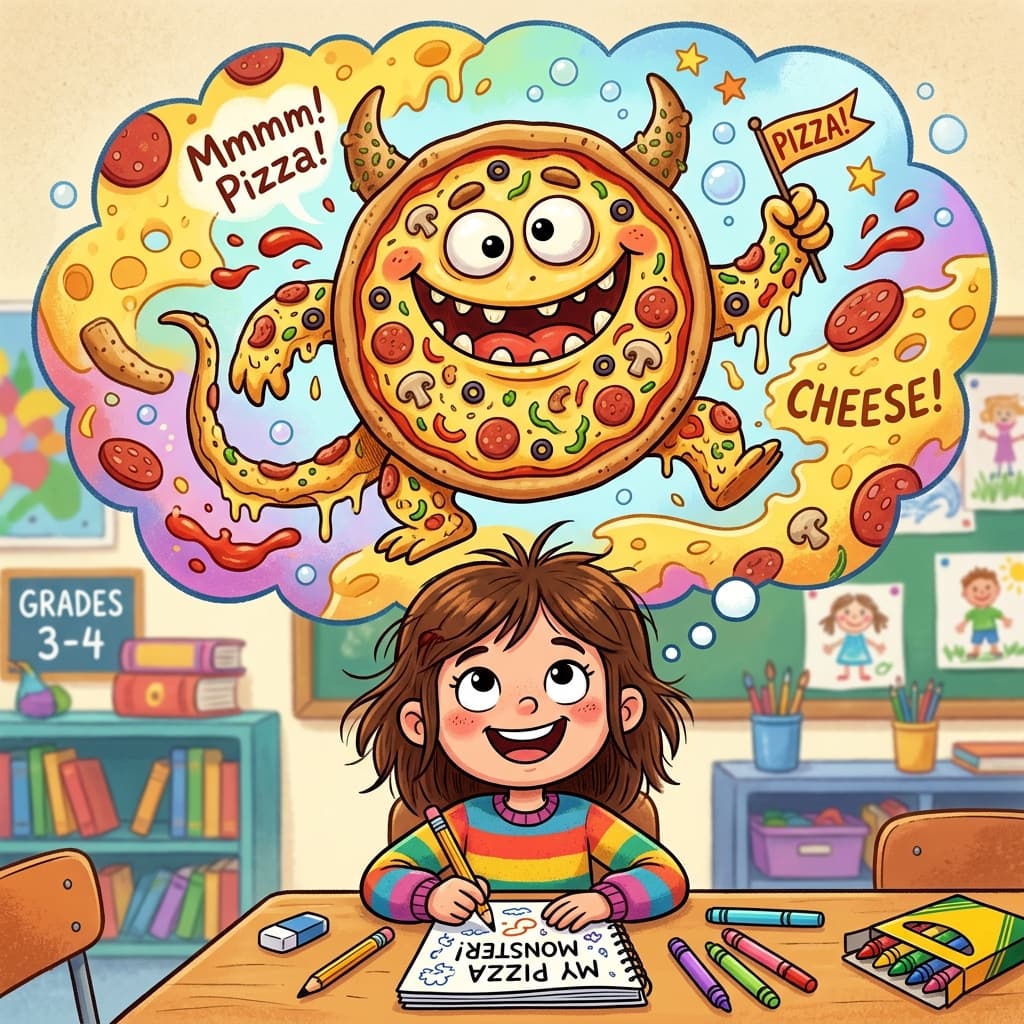
Third grade marks the shift from "learning to write" to "writing to express." Children at ages 8 and 9 have the fundamentals — sentence structure, basic story arc, simple description — but their writing often still reads like a summary of events rather than an experience of them. The reader is told what happened, but not what it felt, smelled, or sounded like.
The developmental focus for 3rd grade writing is sensory detail and character emotion. When a child can describe not just "the dragon" but "the dragon's breath, which smelled like burnt popcorn and old pennies, and the way its scales clicked together like a thousand falling dominoes when it turned to look at you" — they have crossed from functional writing into storytelling.
These 40 prompts are designed to open that door. Each one names a sensory or emotional detail to target, so even children who struggle to self-generate description have a direction.
Why sensory writing matters at this age
Research from the Reading and Writing Project at Columbia University shows that children who learn to write with sensory specificity at ages 8–10 develop significantly stronger reading comprehension skills by middle school. The same cognitive process that produces detailed descriptive writing — holding a vivid mental scene while translating it into language — is the same process that creates rich mental models during reading.
Sensory writing is not a style choice. It is a cognitive skill.
Category 1: Strange Visitors (10 prompts)
"Visitors" give children a specific character to react to — which naturally generates emotional detail.
-
The Invisible Clumsy Friend. Your invisible friend has come to stay for the week. They can't help knocking things over. Describe the sounds of a normal morning in your house now. What does the spilled orange juice smell like? What does your mother's face look like when the third glass breaks?
-
The Alien Exchange Student. An alien named Grxxl joins your class. Describe their appearance (at least three unexpected features), the strange sounds they make when they laugh, and how they react when they eat a peanut butter sandwich for the first time.
-
The Dragon at the Bus Stop. A small, polite dragon is waiting at your bus stop. Nobody else seems to notice. Describe what the dragon's scales look like in the morning light, whether it smells like smoke or something else, and how its wings sound when it folds them.
-
The Giant Who Shrinks. A very tall giant arrives in your town. Over the course of one week, they get smaller each morning. By Friday they are the size of your hand. Write about one meal you share together at each size.
-
The Robot Mail Carrier. A robot has replaced your mail carrier. It is very efficient, but it keeps trying to understand why humans write letters instead of just sending data. Write your conversation about why letters matter.
-
The Grandmother from the Future. Your grandmother shows up — except she's from the year 2087. She looks mostly the same but has three small differences you notice immediately. What does she say about what happens to your city?
-
The Tiny Opera Singer. A man the size of a sparrow lands on your windowsill and begins singing opera very loudly. He explains he lost his way to Carnegie Hall. Describe his voice, what he's wearing, and how the sound fills your room.
-
The Old Lighthouse Keeper. You visit an old lighthouse and meet the keeper — who has been there for 100 years but doesn't look a day older than 40. Describe the smell of the lighthouse, the sound of the water, and the one question he refuses to answer.
-
The Cloud That Landed. A cloud detaches from the sky and lands softly in your school parking lot. It is the size of a school bus. Describe what it feels like to touch, whether it makes a sound, and what you find inside.
-
The Library Ghost. The school library has a ghost who only appears when someone checks out a specific book. You check it out. Describe how you know she's there before you see her.
Category 2: World-Shifting Magic (10 prompts)
These prompts change one rule of reality and ask children to explore the sensory consequences.
-
The Emotion Weather. You find a ring that changes the weather based on your feelings. Write about a full day — morning excitement, afternoon frustration, evening relief — and describe the weather each mood creates.
-
The Color That Disappeared. All green things turn grey overnight. Write your morning walk to school describing everything that has lost its color. What does the world smell like without green?
-
The Backwards Rain. It rains upward today. Describe what you see, what you hear when drops hit the undersides of leaves, and how the puddles on the ceiling of the bus feel.
-
The Time Freeze. Clocks stop for everyone except you. Write thirty minutes of walking through your frozen school. Describe three people caught mid-motion and what their faces tell you about what they were feeling.
-
The Haunted Refrigerator. Every time you open the fridge, you are transported to a different food-themed world. Write two visits: one to the Jellybean Jungle (describe the smell), and one to the Bread Desert (describe the texture and sound underfoot).
-
The Night the Stars Fell. One night, the stars begin falling like slow, warm snowflakes. You catch one in your hand. Describe the weight, the warmth, the light, and whether it makes a sound.
-
The Magical Bakery. You bake a cake that makes anyone who eats it float for exactly one hour. Describe the smell of the batter, what the floaters look like from below, and what it sounds like in the kitchen when everyone is bumping against the ceiling.
-
The Gravity Spot. There is one spot in your backyard — a circle about one metre across — where gravity works in reverse. You discover it at the same time as your neighbor's dog. Write what happens when the dog steps into it.
-
The Inside-Out Forest. The forest behind your house has turned inside out — the trees grow downward, the roots are in the air, and the birds sit in underground burrows. Describe your walk through it.
-
The Ocean in a Bathtub. You turn on the bath and the ocean comes out. Not a lot — just waves, salt smell, and the occasional small fish. Write how you use it before your parents see.
Category 3: Challenges with Specific Sensory Stakes (10 prompts)
3rd graders engage most when the stakes are concrete, immediate, and physical.
-
The Grumpy Cloud. A small raincloud follows only you. It is raining specifically on your head. Describe the cold, wet feeling on your neck, the sound of your soaked shoes, and the conversation you have with the cloud to convince it to leave.
-
The Talking Tree. The oldest tree in the park speaks in riddles. Describe its deep, slow voice, the rough texture of its bark against your hand, and the one riddle you finally solve.
-
The Underwater City. You discover a city at the bottom of the ocean, enclosed in a glass dome. Describe the color of the light coming through the water above, the sound of the ocean pressing against the glass, and one strange feature of the city you can't explain.
-
The Time Machine Malfunction. You travel back to the age of dinosaurs — not a good age to land. Describe the sound of T-Rex footsteps in the mud, the smell of the prehistoric swamp, and the one decision you make in thirty seconds that saves your life.
-
The Mountain of Silence. You visit a mountain where no sound exists. Describe what it's like to walk, to breathe, and to try to call for help. Then describe the exact moment sound returns.
-
The Sand That Remembers. The sand at this beach shows footprints of every person who walked here — going back forever. Describe the oldest tracks you find, what they look like, and what they make you wonder.
-
The Broken Compass. You're in the middle of a forest and your compass spins in circles. Describe how you find your way home using your senses rather than directions.
-
The Cold House. Your heating breaks during the coldest night of the year. Write an hour-by-hour account of how your family adapts — what you eat, where you sleep, and one unexpected good thing that happens.
-
The Perfect Day, Without Sight. Write about a perfect day in your life using only four senses — hearing, smell, touch, and taste. No visual descriptions at all.
-
The Storm Inside. A character carries a storm inside them when they're angry — not metaphorically, literally. Small thunder when they're annoyed, lightning when they're furious. Write one day from their perspective, including how they hide it at school.
Category 4: People Stories (10 prompts)
At this age, children are beginning to understand that other people have full inner lives. These prompts develop empathy through character perspective.
-
The Person Who Sees Colors. A girl in your class sees the world differently — kindness looks blue to her, anger looks red, sadness is grey. Write one school day from her perspective.
-
The Oldest Person in Town. You sit with the oldest person in your town for an hour. She is 101. Write the three things she tells you, and the one question you're still thinking about on the walk home.
-
The Child Who Moved Too Much. Your new classmate has moved eleven times in nine years. Write about the moment they decide whether to make a real friend at this school.
-
The Shy Kid's Victory. A very shy student has to present their project to the class. Write the five minutes before they stand up, the presentation itself, and the one thing someone says afterward that they will remember for years.
-
The Two Brothers. Two brothers — one adventurous, one careful — face the same moment of danger on a hiking trip. Write the scene from both perspectives, alternating every paragraph.
-
The Best Baker in the Family. Your grandmother is the best baker, but she's losing her memory. Write a cooking lesson where she teaches you her secret recipe for the last time.
-
The Lost Tourist. A tourist is lost in your town. They don't speak your language well. Write how you help them find what they're looking for using gestures, drawings, and very simple words.
-
The Kid Who Never Smiles (Until). Write about a character everyone calls "the serious kid" — and the one moment, one ordinary Tuesday, that makes them laugh genuinely for the first time anyone has seen.
-
The Letter to the Past. Write a letter from your current self to yourself at age 6. Include three things you wish you could tell younger you, and one thing that surprised you about growing up.
-
The Thank You That Changes Everything. A character decides to thank every person who helped them in the past year — a teacher, a neighbor, a sibling. Write about the most unexpected reaction they receive.
How to use these in the classroom or at home
For classroom use, the most effective approach is sensory pre-writing: before the child writes a word, ask them to close their eyes and spend 60 seconds building the scene in their imagination. Then ask three questions: What do you see? What do you smell or hear? How does your character feel? Write the answers in bullet points, then begin the story.
MintMyStory can support this as a vocabulary extension: generate a paragraph about the same scene and have the child underline every sensory word the AI used. Then challenge them to replace the AI's adjectives with their own.
Generate a sensory story for your child →
Other grade levels
- 1st Grade Prompts (Ages 6–7)
- 2nd Grade Prompts (Ages 7–8)
- 4th Grade Prompts (Ages 9–10)
- 5th Grade Prompts (Ages 10–11)
- Ultimate Guide to Creative Writing Prompts for Kids
References
- Columbia University Reading and Writing Project. "Units of Study in Opinion, Information, and Narrative Writing." (2023).
- Calkins, L. The Art of Teaching Writing. Heinemann (1994). (Foundational source on sensory writing development.)
- National Council of Teachers of English. "NCTE Position Statement on the Teaching and Learning of Writing." (2016).


