
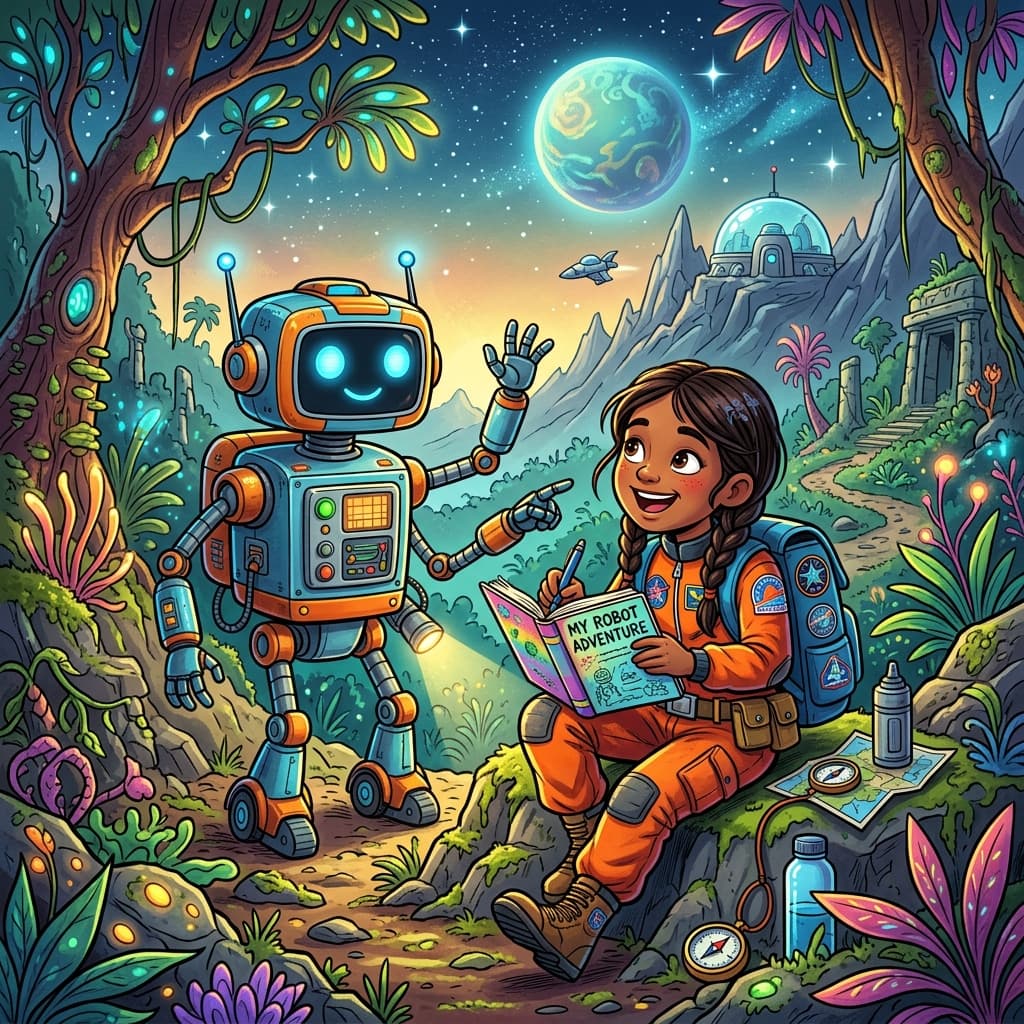
By 4th grade, children understand what a story is. What they struggle with is building one — specifically, sustaining tension over multiple scenes. A 4th grader can write a great first paragraph and a decent ending, but the middle collapses into "and then... and then..." because they haven't yet internalized the engine that drives the middle of a story: escalating stakes.
The prompts below are built around this principle. Every prompt comes with a built-in conflict that must be actively worsened before it can be resolved. A character who loses one tool. A time limit that shortens. A rule that makes the obvious solution unavailable. These constraints are the craft technique writers use to generate plot — and at this age, embedding them directly in the prompt is the most effective way to teach it.
What 4th grade writers need most
Research from the National Council of Teachers of English identifies three specific skills that emerge at ages 9–10 and need direct instruction:
- Sustaining tension: keeping the conflict alive rather than resolving it in the next sentence
- Character motivation: explaining why the character makes their choices, not just what they choose
- Scene-to-scene continuity: each scene should cause the next, not just follow it
These prompts target all three. For each one, encourage your child to ask before writing: What does my character want? What is stopping them? What makes it worse before it gets better?
Category 1: Race Against Time (10 prompts)
Deadlines are the simplest and most effective plot engine. Every prompt in this category has a ticking clock.
-
The Stolen Voice. A mischievous wizard steals the voice of the school's best singer on the day before the talent show. You have until sunset to cross three places, solve three riddles, and retrieve the voice. At each stop, something makes it harder.
-
The Broken Clock. Time freezes for everyone on Earth except you. You have to find the master clock and restart it — but every step you take in the frozen world changes something you can't undo. You have exactly 30 of your minutes.
-
The Rival Inventor. You've spent three months on your science fair project. Your rival sabotages it the morning of the fair. You have 90 minutes before judging. The only tools available are: a broken fan, some string, two magnets, a cardboard tube, and a jar of glue. Write the rebuild.
-
The Island Tide. You and your brother are exploring a tidal island when you realize the tide is coming in faster than expected. Your brother has twisted his ankle. The path back is underwater in 40 minutes. Write what you do at 40, 25, and 10 minutes remaining.
-
The Midnight Rule. A spell was accidentally cast on your town: anyone still outside at midnight becomes part of the night sky — permanently. You are outside. You have until midnight. It is 11:17 PM. Write your run home.
-
The Last Train. The last train of the night leaves in 20 minutes. If you miss it, you are stranded in an unfamiliar city. Your phone is dead. Your wallet fell out on the subway. Write the 20 minutes.
-
The Melting Castle. You are inside a magical ice castle that is melting — slowly, but definitely. Inside is a locked room with something that belongs to your best friend. The ice is soft enough to scratch but hard enough to climb. You have about an hour before the architecture becomes dangerous.
-
The Competition. The annual inter-school spelling championship. You are the last contestant for your school. The word you've drawn is one you've never seen. You have 30 seconds. Write the 30 seconds in as much detail as possible.
-
The Rescue. Your dog has fallen into a ravine. It's not deep enough to be fatal, but it's steep enough that she can't climb out. The sun sets in 45 minutes and it gets cold fast here. You have a backpack with: a rope, a granola bar, a rain jacket, and a small flashlight.
-
The Experiment Gone Wrong. Your science experiment has gone wrong in a way that has covered the entire kitchen in an expanding foam. It doubles in volume every five minutes. Your parents get home in 35 minutes. Write the solution.
Category 2: The Rule That Makes It Harder (10 prompts)
In real storytelling, the best constraints are ones that make the obvious solution unavailable. These prompts give your character one rule they cannot break.
-
The Rule Breaker's Sweater. In a town where everyone must wear the color blue, you wake up in a red sweater you cannot remove — not because it's stuck, but because removing it reveals something worse. You have a full school day to survive.
-
The Honest Thief. You are a character who physically cannot lie. You have accidentally taken something that wasn't yours — not on purpose, but the owner doesn't know that. You have to return it and explain yourself without being able to say anything untrue.
-
The Silent Hour. Every day from 2–3 PM, the village goes completely silent by law. Anyone who makes a sound during this hour must leave the village forever. Today, during the silent hour, you see something that requires you to warn someone. You cannot speak.
-
The Invisible Line. There is a line down the middle of your town. Your family lives on the left side. The thing you need is on the right side — but you are not allowed to cross. The rule exists for a reason. You discover what the reason is while trying to get around it.
-
The Memory Rule. A magical school rule: you forget everything you learned today the moment you step outside the school. You have to pass tomorrow's test. You have to figure out how to bring the learning home without taking it out the door.
-
The Promise. You promised your best friend you would be at their performance at exactly 6 PM. At 5:30 PM, something happens that requires you to help a stranger. Helping the stranger will make you late. Breaking the promise will hurt your friend. There is no third option. What do you choose, and write the consequences.
-
The Sleeping City. A spell makes everyone in the city fall asleep at 8 PM. You are immune. Every night, you have the sleeping city to yourself — but you cannot take anything with you when morning comes. One night you find something that must be removed before morning.
-
The No-Magic Zone. You have magic. The place where you need to go has no magic. Inside that zone, your powers don't work. The thing you're afraid of also can't use magic there. Write the scene where you both arrive at the line at the same time.
-
The Price. Every wish you make comes true — but costs you exactly one memory. The memories disappear in reverse chronological order. You have already used four wishes. Write the moment you realize the fifth one will cost you a memory you can't afford to lose.
-
The Agreement. You signed a contract (you didn't read it carefully) agreeing not to use your hands for 24 hours. Four hours in, you realize you desperately need them. Write the creative solutions you find — and the one moment you almost break the agreement.
Category 3: Accidental Heroes (10 prompts)
These prompts put the character in a situation where they have to save something they didn't intend to get involved with.
-
The Accidental Hero. A villain tries to take over the city, but their weapon accidentally gives you superpowers. You didn't ask for them. You have no idea how to use them. But you are the only one who can stop this. Write your first attempt.
-
The Two Moons. A second moon appears overnight. It's pulling the tides dangerously high. You discover a map showing how to send it away — but the map is written in a language only one person in town can read, and that person doesn't know they can.
-
The Animal Rebellion. The zoo animals have learned to unlock their cages. They're not dangerous, just angry about something specific. You are the only child who can understand what they're saying. Write what they want, and the negotiation between the zoo director and the animals.
-
The Lying Mirror. A mirror in the old house shows a darker version of the world — one where things went badly. One day, your reflection steps out and tries to replace you. It looks exactly like you. It knows everything you know.
-
The Sleepy Mountain. The mountain behind your town is actually a sleeping giant. After 200 years, something is waking it up. The giant is not evil — just confused and enormous. You have to figure out why it's waking and solve the problem before it rolls over.
-
The Invisible Enemy. Something is eating the library's books — from the inside. The words are disappearing from the pages overnight. You figure out what it is. It turns out to be lonely.
-
The Forgotten Kingdom. A door appears in the school basement. Through it is a kingdom that was put on hold 300 years ago — everyone frozen mid-action. They need one thing to unfreeze. The thing is somewhere in your school.
-
The Message in the Machine. The school's ancient photocopier starts printing documents that no one sent — old messages from 30 years ago, from students who graduated. The messages form a pattern. The pattern points to something buried under the playground.
-
The Smallest Dragon. The largest dragon in history lived in this valley 500 years ago. You find its last egg — undersized, overlooked. The egg hatches. The dragon inside is tiny, friendly, and absolutely cannot be discovered by anyone else in town.
-
The Storm That Followed. A storm cloud has been following your class for a week. Only rains on your class specifically. Your classmates are frustrated. You figure out it's following one specific student — and why.
Category 4: Choices That Cost Something (10 prompts)
These prompts teach children that the best stories require characters to give something up. The cost makes the choice meaningful.
-
The Last Superpower. You have one superpower left. Using it will solve the current crisis — but permanently. After this, you are ordinary again. Write the moment of decision and everything that follows.
-
The Trade. An ancient spirit offers you one thing you desperately want in exchange for one thing you didn't realize you were willing to give. Write the negotiation and whether you take the deal.
-
The Truth That Changes Everything. Your character discovers something true about a person they disliked. The truth makes the situation much more complicated. Write how your character responds.
-
The Shortcut. There is a shortcut to success that is technically allowed but feels wrong. Your character can take it or do it the hard way. The hard way may not work. Write both paths — one paragraph each — then choose which one your character takes and continue that story.
-
The Apology. The character who made the biggest mistake of the story has to apologize to someone. Write the apology — not just the words, but the physical details: what they do with their hands, whether they can make eye contact, what the other person does before they respond.
-
The Fair Decision. Four people need one thing. There is only enough for two. Your character has to decide who gets it. Write how they decide, and write one scene for each of the two who didn't get it.
-
The Gift That Costs. Your character can give someone a gift that will change that person's life permanently for the better — but it requires your character to give up something they love. Write the decision and the moment after.
-
The Report. Your character witnesses something. Reporting it will get someone they care about in trouble — someone who made a mistake, but not on purpose. Not reporting it means something continues to go wrong. Write what they do.
-
The Return. Your character has been carrying something that doesn't belong to them for a long time. Returning it means admitting they had it. Write the return — and what they discover when the other person's reaction is not what they expected.
-
The Real Reason. Every character in this story has been motivated by something they haven't told anyone. At the end of the story, write the same scene three times — once from each of three characters' perspectives — revealing what each one was actually trying to do.
How to use these in the classroom
The most effective approach for 4th grade is conflict mapping before writing. Draw three boxes: What does the character want? What stops them? What makes it worse? Fill in the boxes from the prompt before writing a word.
When a student gets stuck in the middle, ask: "What is the one thing that would solve this — and why can't they use it yet?" The answer to that question is always the next scene.
MintMyStory can be used as a plot-generation tool for stuck writers: input the premise, generate a short story, then have the student identify the three boxes in what the AI produced. Then challenge them to write a version where the middle is worse before it gets better.
Use MintMyStory as a story-building tool →
Other grade levels
- 1st Grade Prompts (Ages 6–7)
- 2nd Grade Prompts (Ages 7–8)
- 3rd Grade Prompts (Ages 8–9)
- 5th Grade Prompts (Ages 10–11)
- Ultimate Guide: Creative Writing Prompts for Kids
References
- National Council of Teachers of English. "NCTE Standards for the English Language Arts." (2022).
- Fletcher, R., & Portalupi, J. Craft Lessons: Teaching Writing K–8. Stenhouse Publishers (2007). (Source for escalating stakes technique.)
- Calkins, L. Units of Study in Opinion, Information, and Narrative Writing. Heinemann (2013).


