
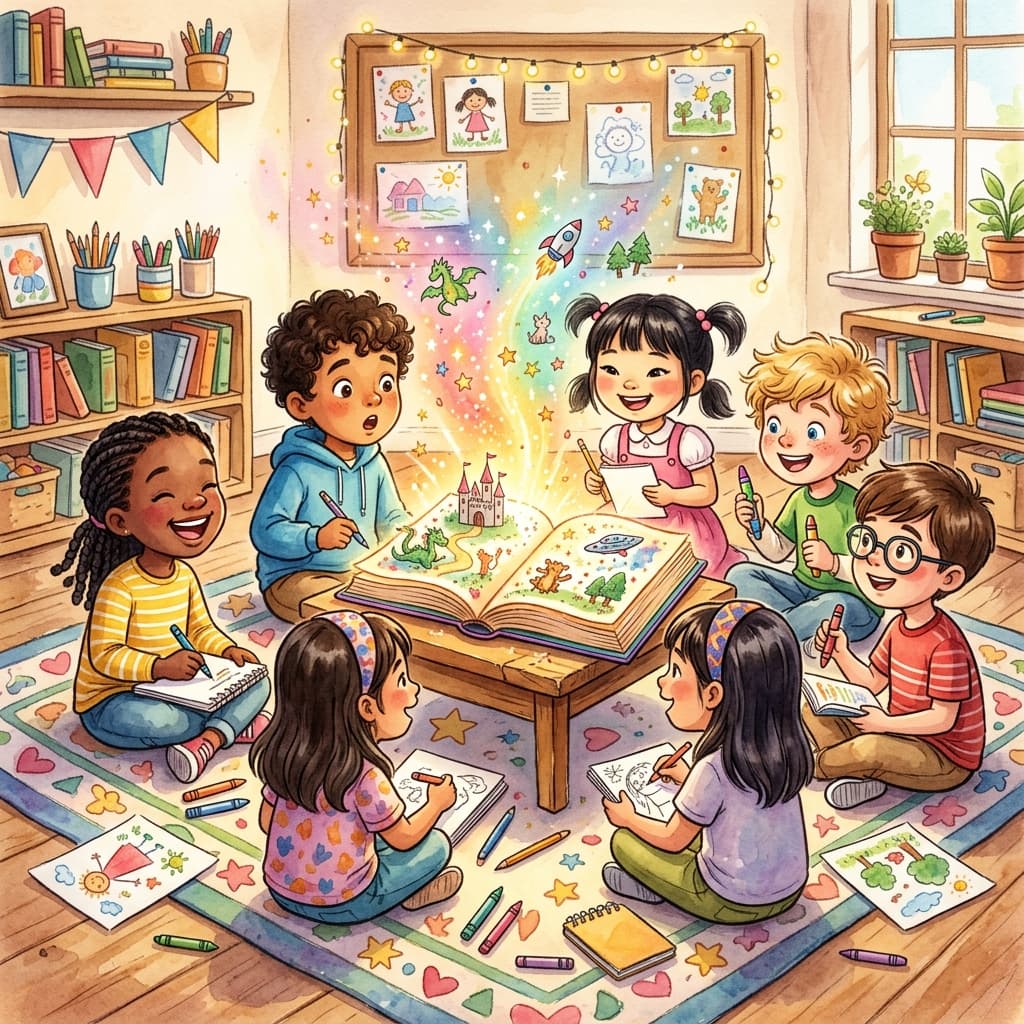
Writing in 1st grade is one of the biggest milestone transitions in early literacy. Children at ages 6 and 7 can speak in complex narratives — they can tell you a 10-minute story about what happened at recess with full emotional arc and character differentiation. The problem is mechanical: the physical act of writing is slow, spelling is unpredictable, and the gap between imagination and output is frustrating.
Research from the National Writing Project shows that 1st graders who are given structured prompts — not blank pages — show significantly better engagement and longer writing sessions than those given open-ended assignments. The prompt does the hardest cognitive work (generating a premise) so the child can focus on building it.
These 40 prompts are organized by category and calibrated for a 1st grader's actual cognitive world: immediate, sensory, relatable, with a small twist that opens the story.
A note on "inventive spelling"
At this age, do not correct spelling during the drafting phase. Research consistently shows that correcting spelling mid-story interrupts working memory and causes children to shorten their output to only words they can spell confidently. Let them write phonetically. Fix it during the revision phase (if at all). The goal at 6–7 is to build the identity of a storyteller, not a speller.
Category 1: Magical Animals (10 prompts)
These are the highest-engagement prompts for 1st graders. Animals are emotionally safe — they project without self-consciousness.
- The Pocket Dinosaur. You find a tiny dinosaur the size of your hand. He can talk, but only in rhymes. What's the first thing he says to you?
- The Backwards Dog. Your dog wakes up one morning and walks backward everywhere. Nobody can figure out why. You are the only one who understands what happened.
- The Worried Elephant. The elephant at the zoo is scared of mice. You have to help him be brave before the mouse gets to the petting zoo section. How?
- The Cat's Secret Job. While you're at school, your cat goes to work. What is their job? What happens on their busiest day?
- The Very Sleepy Bear. A bear wanders into your classroom and falls asleep in your chair. School has to keep going. What do you do?
- The Goldfish Who Could Fly. Your goldfish's bowl fills with air instead of water one morning. Now your goldfish floats around the house like a balloon. Where does it go?
- The Kind Spider. You're afraid of spiders, but this one keeps leaving you helpful notes. What do the notes say?
- The Singing Cow. A cow shows up at your school talent show and sings better than anyone. Does she win? What happens after?
- The Birthday Turtle. A turtle arrives at your door carrying a present. The present is from someone who moved away. What's inside?
- The Horse Who Hates Mud. This is a horse's biggest problem, and it just rained for a week. She needs your help planning a route to school that avoids every puddle.
Category 2: Magic & Transformation (10 prompts)
At this age, children delight in rules-based magic. Give the magic a constraint and watch them problem-solve.
- The Magic Breakfast. Every morning for one week, your cereal has a different magical power. What does Monday's cereal do? What about Friday's?
- The Invisible Tuesday. On Tuesdays only, you become invisible. You decide to use this power to help someone. Who, and how?
- The Growing Shoes. Every step you take makes you grow one inch. You start at school. How do you get home before you're too tall to fit through the door?
- The Wish That Went Sideways. You wished for a swimming pool. You got one. It appeared in your bedroom. Now what?
- The Talking Mirror. Your bathroom mirror can only say one true thing to you each morning. What has it been saying lately? One day it says something surprising.
- The Color That Disappeared. You wake up and the color blue is gone from the entire world. What looks different? What do you miss most?
- The Rainy Candy. For ten minutes, it rains your favorite candy. You have to decide quickly: fill your own bucket, or share it with the whole street?
- The Backwards Day. Time runs backward today only. You eat dinner first and wake up at the end. Write three things that are funny about this day.
- The Magic Pencil. Your pencil draws things that come to life — but only if you draw them carefully and kindly. What do you make first?
- The Dream You Finished. You're in the middle of a really good dream and your alarm goes off. But this dream has a door — and you can go back through it at lunch. What do you find?
Category 3: Everyday Adventures (10 prompts)
These are grounded in real life with one small twist. Good for children who prefer realistic fiction.
- The Wrong Bus. You get on the wrong bus home. You don't know where it's going. Write the three most interesting stops it makes.
- The Lost Lunchbox. Your lunchbox is missing. You retrace your morning step by step. At each place, you find a clue. Where did it go?
- The Substitute Teacher. The substitute teacher for the day is a pirate. (A very polite one.) What does she teach? What rules does she make?
- The Rainstorm Inside. It starts raining inside your classroom. Not much — just a light drizzle over the reading corner. The teacher decides to continue class anyway.
- The New Kid. A new student arrives at school. They seem nervous. You decide to help. What's the first thing you do, and what do you learn about them?
- The Elevator That Went Sideways. You get into an elevator at the grocery store. Instead of going up or down, it goes sideways — through the wall, into the next building. What's there?
- The Library Book That Wrote Back. You write your name in the library book return slip. The book writes something back. It's short: "You need to read page 47 tonight."
- The Map. You find an old map in the school library. It shows a room in your school that you've never been to. You go looking.
- The Jar of Stars. Your grandmother gives you a jar of real stars for your birthday. She says "only open it when it's dark and you're brave enough." When do you open it, and what happens?
- The Birthday Balloon. A balloon from someone else's birthday party floats to your window with a note attached. The note is an invitation.
Category 4: Brave Feelings (10 prompts)
These are the most educationally valuable prompts — they help children process emotions through narrative distance.
- The Day I Was Nervous. Write about a time you were nervous about something new. Now write what you would say to yourself at the beginning of that day.
- The Monster Under the Bed (Who Is Nice). This monster has been under your bed for a year. He's actually very shy. Tonight you both decide to talk for the first time.
- The Apology Letter. You accidentally broke something that belonged to your best friend. Write them a letter — not just "I'm sorry," but the whole story of what happened and what you'll do next.
- The Big Jump. There's a diving board at the pool. You've been watching it for three summers. Today you decide to go. Write every step, from the ladder to the water.
- The Sick Day. You're home sick from school. Everything is quiet. Write about three things you notice when the house is this quiet that you never notice normally.
- The Goodbye. Your best friend is moving to a different city. Write the conversation you have on the last day. Include at least one funny memory and one thing you're going to miss.
- The First Try. Write about learning something hard — a bike, a cartwheel, a new word, anything. What was the first try like? The fifth? The time it finally worked?
- The Thing Nobody Knows. Write about something you're good at that not many people know about. A skill, a habit, a funny talent. How did you discover it?
- The Question I Was Afraid to Ask. There's something you wanted to ask a grown-up but felt weird about. Write it as a story where a character asks the question — and what the grown-up answers.
- The Thank You. Think of someone who helped you this year. Write them a thank-you — not just "thank you for X," but the whole story of why what they did mattered.
How MintMyStory helps 1st graders
For children at this age, MintMyStory works best as a dictation-to-story tool. Here's the workflow:
- Read the child a prompt from this list.
- Ask them to tell you the story out loud. Record it on your phone or take dictation notes.
- Type the key plot points into MintMyStory.
- The AI illustrates and narrates it.
When your child hears their own story read back to them — with illustrations — the cognitive reward is significant. They see their imagination as a real, physical artifact. This is one of the most effective early confidence-builders for reluctant writers.
Turn your child's story idea into an illustrated book →
Looking for a different grade level?
- 2nd Grade Prompts (Ages 7–8)
- 3rd Grade Prompts (Ages 8–9)
- 4th Grade Prompts (Ages 9–10)
- 5th Grade Prompts (Ages 10–11)
- Ultimate Guide: Creative Writing Prompts for Kids
References
- National Writing Project. "Writing Project Research." (2023). nwp.org
- Graham, S., & Perin, D. "A meta-analysis of writing instruction for adolescent students." Journal of Educational Psychology, 99(3), 445–476 (2007).
- Bear, D. R., et al. Words Their Way: Word Study for Phonics, Vocabulary, and Spelling Instruction. Pearson (2016). (Source for inventive spelling research.)


